
Children Literature Program
Promoting reading in classes will develop literary appreciation and awareness. However, children need to experience the literature on their own instead of starting by analyzing the formal aspects of it. Furthermore, teachers are responsible for diffusing that enjoyment and pleasure that literature is able to provide, and they also must create innovative strategies to promote reading in their students.

Instead of working on worksheets, children can develop various ways to enhance reading comprehension. Teachers should read aloud to kids and reread favorite stories to help them build that enjoyment that is pursued but always considering children’s needs.
Providing real books in the classroom is a relevant aspect to create enthusiastic readers, students should be able to access the books of their interest when they need them, this environment is crucial if teachers want to create a life habit in their children.
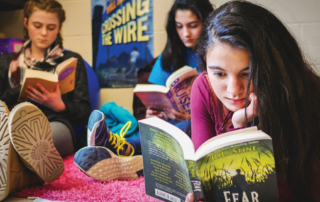
Connecting books in the curriculum are fundamental if the aim of the school is to promote reading as a lifetime activity. However, the problem comes when teachers try to evaluate the progress of students. However, literature should not be evaluated based on tests; evaluation should be based on the observation of each student’s process, and the abilities they demonstrate in the activities the teacher prepares for the class.
Kiefer, B. Tyson, C (2009) Charlotte Huck's Children's Literature: A Brief Guide. Planning the literature program. McGraw-Hill Higher Education.

Hi, Diego. It is absolutely true that ss are the ones who are supposed to have their first approach to litterature by theyr own but thinking about our context that is a little bit hard. Parents' job when having their kids closer to literature is also an issue but here I want to focus on how we address learning literature.
ReplyDeleteAt first it is possible to question ourselves if literature is something that can be laerned, if it's so, how do we ''teach it'' and even more difficult how do we grade it?
Altough you are mainly talking about children and teenagers, we as university students also struggle with our forced relationships with literature.
We all know what are the struggles that's why I'm going to focus on the possible solution. Keeping in mind famous proposals such as Pavlov and his idea of associative learning, it is possible to question the organization of our literature subjects at th univeristy. Following one of the principles of associative learning consists on wrking on top of what has been already built, however the first approach we have with litterature there, is the Spanish one. It wouldn't be a big deal if the way it is presented would have been different but, since we are ''colombians'' and live in a certain context that with time becomes normal to us, it would be perfect to see that context portrayed on literature. In that order of ideas, Colombian literature should go first on the programs. That way ss will associate their context and experiences with the inmediate text.
This is just a simple example of how simple things can actually change the way we approach and perceive literature.
It is time for us to open our minds, specially when having ''inexpert'' readers that are just getting familiar with literature, it is up to us to be prepared and attentive to guide as much as possible, but most imporntantly, to cause hunger in students. Hunger for reading. After that, critial sense and different kinds of lecture can be developed.
I completely agree with your statement of providing real books in the classroom. The environment is a critical aspect to consider in order to promote reading enjoyment. However, I have not seen a Colombian classroom with a reading corner or a small library in it. It is evident that there are schools that do not count with a library and that do not offer enough books for students. In addition, the scarce books that you may find in a classroom are not all interesting or engaging for the students. Definitely, students need exposure to different types of printed texts. They should be able to hold them and to experience various formats, styles, and genres.
ReplyDeleteJoseph Nhan-O’Reilly (2014) asserts that as a teacher you can play an important role in supporting your students’ reading and learning by ensuring that they have access to books in the school classroom. Bearing this in mind, what strategies would you implement to change a classroom environment and provide physical books to your students, considering that our classrooms have more than 30 learners in a small space and that we do not count with the necessary resources to get such amount of books for every student.